
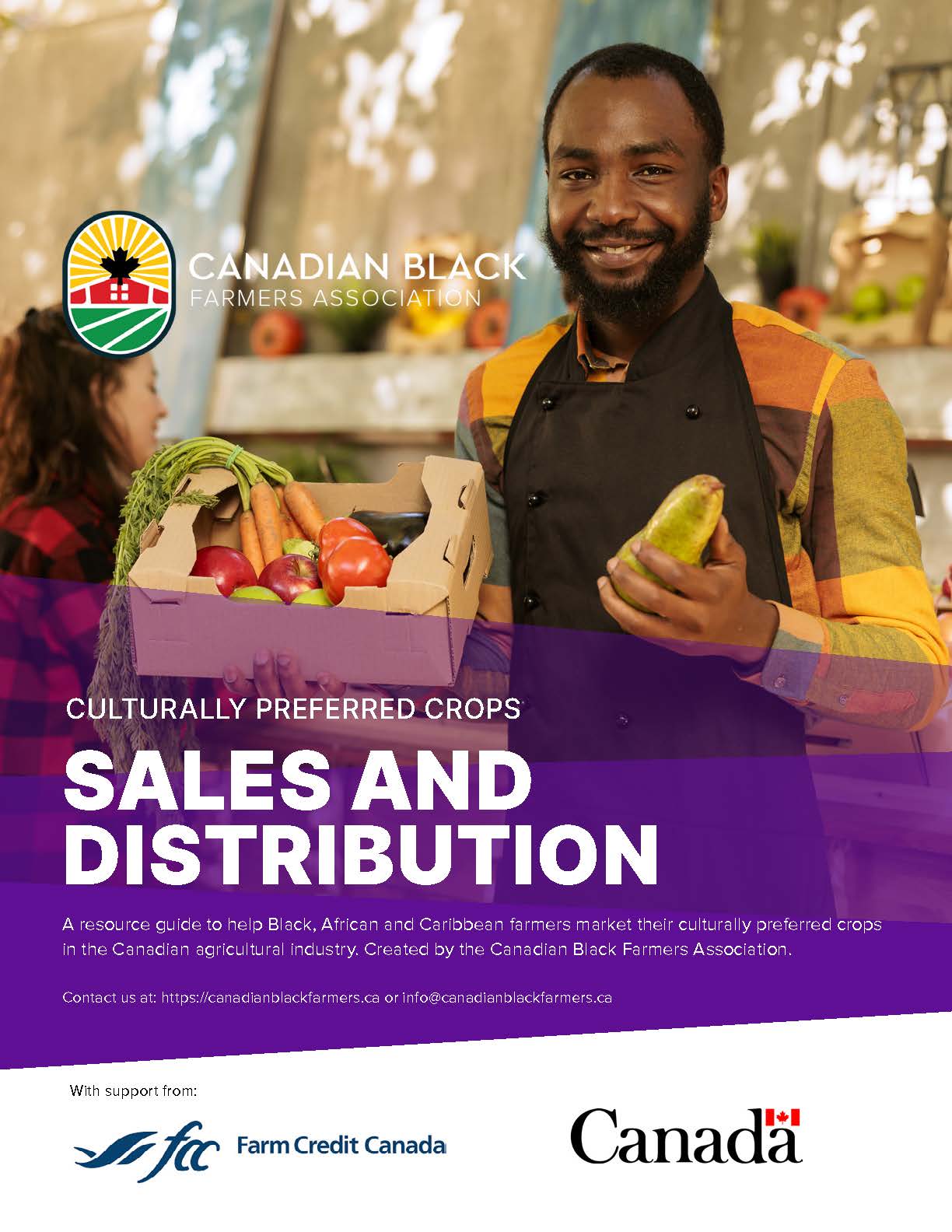
The Canadian Black Farmers Association is producing a series of resource guides to help you navigate your way through the agricultural industry here in Canada. This guide focused on the Sales & Distribution of culturally preferred crops to Black, African and Caribbean consumers in Canada.
You can click to download our full PDF, or scroll down to read the guide content right online. Use the table of contents on the right to help you find your way to areas of interest.
Sales & Distribution of Culturally Preferred Crops in Canada
Introduction
For Black, African, and Caribbean (BAC) farmers in Canada, cultivating culturally meaningful crops is a pathway to food sovereignty, community wellbeing, and economic empowerment. This guide supports farmers beyond production, helping you understand post-harvest handling, pricing, packaging, regulations, logistics, distribution channels, and cultural branding.
The goal is simple:
Help you build profitable, sustainable, culturally aligned businesses that connect diaspora communities with familiar foods.
This guide includes detailed sections on:
- Crop Selection
- Quality Control
- Post-Harvest Handling
- Packaging
- Pricing Strategies
- Transportation & Logistics
- Marketing & Sales
- Regulatory Compliance (National & Provincial)
- Record-Keeping
- Review & Evaluation
- Local and National Distribution Channels
- Tools, Equipment, and Logistics Partners
- Value-Added Products
- Farmers’ Markets Across Canada
- Cooperative Models and Shared Infrastructure
- E-Commerce and Online Sales Platforms
- Cultural Branding and Storytelling
- Funding and Support Programs (Black-specific + Agricultural programs)
Crop Selection
Select culturally preferred crops that match both community demand and Canadian growing conditions. Popular crops include:
- Okra
- Callaloo / African amaranth
- Scotch bonnet & African peppers
- African eggplant / garden eggs
- Bitter leaf
- Jute leaves
- Egusi melon
- Sweet potato leaves
- African garden eggs
How to choose crops effectively:
- Engage your community through informal conversations, focus groups, churches, and cultural centres.
- Talk to restaurants & grocers to understand high-demand items that are often imported.
- Trial unfamiliar crops in small plots or hoop houses.
- Assess seed access from international suppliers, African/Caribbean stores, or community exchanges.
- Track climate adaptability — prioritize short-season crops or greenhouse-friendly varieties.
Rotating crops and using traditional intercropping methods improves soil health and aligns with ancestral farming practices.
Quality Control
A consistent quality system builds trust with buyers and ensures your products meet expectations.
Quality indicators include:
- Freshness
- Colour and shape
- Ripeness
- Absence of pests, mold, or rot
- Uniformity for retail buyers
Best Practices:
- Harvest at peak maturity for flavour and shelf life.
- Train workers in hygiene and inspection protocols.
- Use food-safe tools and containers.
- Grade produce (premium, standard, seconds).
- Redirect imperfect produce into value-added products like sauces or frozen greens.
Consistent quality reduces returns, protects relationships with buyers, and strengthens your professional reputation.
Post-Harvest Handling
Good post-harvest handling preserves freshness, prevents spoilage, and increases market value.
Key steps:
Leave stem on
When harvesting stemmed vegetables (tomatoes, peppers) leave the stem on to prolong shelf life.
Remove field heat quickly
Use shade tents during harvest and cool storage (fans, ice packs, refrigeration).
Clean gently
Rinse produce with potable water using low pressure. Avoid scrubbing delicate greens.
Use food-safe containers
Ventilated crates or bins reduce moisture buildup.
Sanitize tools & surfaces
Clean knives, bins, tables, and storage areas before and after use.
Reduce handling
Fewer hands = fewer bruises and longer shelf life.
Cold storage
Use walk-in coolers, portable coolers, or shared cold storage facilities.
Develop written SOPs for harvest, washing, and packing to align with food safety standards and CFIA requirements.
Packaging
Packaging ensures freshness, communicates your brand, and meets Canadian labeling standards.
Recommended packaging types:
- Perforated clamshells
- Mesh produce bags
- Compostable wraps
- Breathable food-safe plastics
- Tamper-evident seals
Essential labeling elements:
- Common name (English & French)
- Net weight
- Farm name and address
- Lot number or batch code
- Packing date
- Country of origin
Branding tip: Use cultural patterns, Afrocentric fonts, or storytelling on labels for immediate recognition.
Canadian suppliers:
- FoodPak (BC)
- Canpaco (ON)
- Duropac (QC)
- Eco Guardian (national)
Pricing Strategies
Your pricing must cover costs and reflect the cultural value of your products.
Step 1: Calculate the true cost of production
Include:
- Seeds
- Soil inputs
- Labour
- Packaging
- Transport
- Storage
- Market fees
Step 2: Choose a pricing model
Cost-plus pricing
Price = Production Cost + Profit Margin
Value-based pricing
Higher cultural value crops may command higher prices.
Step 3: Create pricing tiers
- Wholesale
- Retail
- CSA subscriptions
- Restaurants
- Institutional buyers
Example calculation:
| Item | Cost to Produce | Profit | Retail Price | Wholesale Price |
| 1 lb okra | $2.50 | $1.00 | $3.50/lb | $2.80/lb |
Transparent pricing builds trust with customers and partners.
Transportation and Logistics
Efficient logistics ensure products remain fresh from farm to buyer.
Cold Chain Management
“Ideal temperature: 0–4°C for most leafy greens.”
Use:
- Insulated bins
- Refrigerated vans (rented or shared)
- Cold packs and liners
Delivery Techniques
- Establish consistent delivery days
- Use GPS routing tools
- Track deliveries with invoices, receipts, and logs
Shared delivery with other small farmers reduces cost and increases efficiency. Ensure your delivery process follows food safety protocols and is HACCP-compliant, especially when working with commercial buyers. https://www.foodsafety.ca/haccp-programs/what-is-haccp
Marketing and Sales
A strong sales strategy elevates your farm, your story, and your products.
Sales Channels
Direct-to-Consumer
- Farmers’ markets
- Community events
- Pop-up markets
- CSA programs
- WhatsApp or community pre-order lists
Retail Partnerships
- Approach Afro-Caribbean and multicultural grocery stores with:
- Samples
- Shelf-ready packaging
- Marketing posters or recipe cards
Restaurants & Food Service
- Target Black-owned and multicultural establishments. Offer sample boxes.
Online Sales
- Platforms:
- Shopify
- Local Line
- Square
- Instagram Shops
- Facebook Marketplace
Cultural Branding Tips
- Highlight heritage crops and ancestral knowledge
- Tell your farm story
- Share cooking instructions, recipes, and videos
- Use QR codes linking to farmer bios or preparation tips
Authentic storytelling increases customer loyalty and cultural education.
Regulatory Compliance (national & Provincial)
Navigating Canada’s food safety and regulatory landscape is essential for Black farmers cultivating culturally significant crops. Compliance ensures product integrity, consumer safety, and access to broader markets.
Federal Regulations:
- Safe Food for Canadians Act (SFCA) and Safe Food for Canadians Regulations (SFCR): These govern food safety, licensing, traceability, and labeling for interprovincial trade and exports. Canadian Food Inspection Agency
- Food and Drugs Act (FDA) and Food and Drug Regulations (FDR): They oversee food safety standards, including permissible additives and nutritional labeling.
Licensing and Preventive Controls:
- Licensing: If you import, export, or sell food interprovincially, you must obtain a license from the Canadian Food Inspection Agency (CFIA). Canadian Food Inspection Agency
- Preventive Control Plan (PCP): Developing a PCP is mandatory for most food businesses. It outlines how you identify and manage food safety risks. Canadian Food Inspection Agency
Traceability Requirements:
Traceability systems must track:
- One step forward: Know who you sold your product to.
- One step back: Know where you sourced your inputs.
Maintain records for at least two years to facilitate recalls if necessary.
Labeling Requirements:
For fresh fruits and vegetables:
- Common Name: Clearly identify the product (e.g., “Callaloo Leaves”).
- Net Quantity: State the weight or volume in metric units. Canadian Food Inspection Agency
- Name and Address: Include the name and principal place of business. Country of Origin: Indicate where the product was grown. https://inspection.canada.ca/en/food-labels/labelling/industry/fresh-fruits-vegetable
- Bilingual Labeling: Mandatory information must be in both English and French. https://inspection.canada.ca/en/food-labels/labelling/industry/bilingual-food-labelling
Provincial Regulations:
In addition to federal laws, provinces have specific regulations:
- British Columbia: BC Food Safety
- Ontario: OMAFRA Food Safety
- Quebec: MAPAQ Food Safety
- Alberta: Alberta Food Safety
Resources for Compliance:
- CFIA Guidance Finder: CFIA Guidance https://inspection.canada.ca/en/food-safety-industry
- Industry Labelling Tool: Labelling Tool and https://inspection.canada.ca/en/food-labels/labelling/industry/requirements-checklist
Staying informed and compliant not only ensures the safety of your products but also builds trust with consumers and opens doors to new markets.
Record-Keeping
Accurate records strengthen your business and support grant eligibility.
Track:
- Planting dates, inputs, yields
- Customer lists
- Invoices & sales
- Inventory
- Food safety logs
- Staff training
- Funding applications
Use:
- QuickBooks
- Excel
- AgExpert
- Google Drive or cloud storage
Review & Evaluation
Ongoing evaluation allows farmers to make informed decisions, improve operations, and maximize impact. By analyzing data and community feedback, Black farmers can fine-tune crop plans, pricing, distribution strategies, and customer service.
What to review:
- Sales trends: Track which crops sold best by month, market, or outlet.
- Customer feedback: Collect responses from CSA members, retailers, and market customers about product quality, availability, and preferences.
- Expenses vs. revenue: Analyze profit margins and identify cost-saving opportunities.
- Production performance: Evaluate yield per square foot, crop loss percentages, and weather-related impacts.
- Partner performance: Assess grocery or distributor relationships, payment timelines, and delivery success rates.
Evaluation tools:
- Spreadsheets, farm management apps (AgExpert, Tend), surveys (Google Forms), and year-end financial reports.
- SWOT Analysis: Identify Strengths, Weaknesses, Opportunities, and Threats.
When to review:
- Monthly (mini-check-ins)
- Seasonally (after major harvests or market cycles)
- Annually (strategic planning and grant reporting)
Use insights to adjust planting schedules, scale back or expand certain crops, re-negotiate contracts, or revise your customer engagement approach. Thoughtful review is a cornerstone of continuous improvement and long-term sustainability.
Local and National Distribution Channels
Expanding your distribution network is key to reaching new customers and ensuring your culturally appropriate crops are available in communities across Canada.
Distribution Options:
- Independent Afro-Caribbean grocers: Establish supply relationships with small grocers catering to diaspora communities. These stores are often willing to stock culturally specific produce that is fresh and locally grown.
- Farmers’ markets and CSA programs: Offer direct-to-consumer sales through subscription boxes or local pickup.
- Restaurants and caterers: Focus on Black-owned and multicultural food businesses that prioritize authenticity and freshness. Offer sample boxes or custom orders.
- Online and App Sales: There are new farm to market sales apps being created, keep up to date by connecting with other local farmers and distributors for sales and distribution apps for food and food processors. For example, Afrikdish
Major National Chains:
- Loblaws, Metro, Sobeys, Walmart, Costco
- Save-On-Foods, Fresh St. Market, Safeway
- Food Basics, Longo’s, No Frills
- IGA, Super C, Marché Bonichoix
- Atlantic Superstore.
Tools, Equipment, and Logistics Partners
Efficient sales and distribution of culturally appropriate crops require the right tools, infrastructure, and service providers. Investing in or accessing the correct equipment can reduce waste, improve efficiency, and help ensure compliance with food safety regulations.
Essential Tools and Equipment:
- Packaging tools: Heat sealers, bag clips, zip-lock machines, and labelling devices
- Cold storage units: Walk-in coolers, upright fridges, and mobile coolers for field use
- Transport containers: Food-safe crates, insulated bins, pallet jacks, and dolly carts
- Harvest tools: Sharp harvest knives, harvesting aprons, gloves, and shade tents
- Digital systems: Inventory software, farm management tools (e.g., AgExpert, Tend), mobile invoicing apps, and barcode printers
Food-Grade Logistics and Packaging Partners (By Region):
- British Columbia: FoodPak (packaging and vacuum sealing systems), Gordon Food Service (distribution)
- Ontario: Canpaco (packaging), GoBolt (eco-friendly urban logistics), SHIPHYPE (third-party fulfillment)
- Quebec: Duropac (food packaging), Courant Plus (regional transport)
- National Providers: Eco Guardian (compostable packaging), UniUni (e-commerce delivery)
Shared Access Options:
- Farm cooperatives: Join local food co-ops that offer shared access to large-scale equipment like refrigeration or label printers.
- Incubator kitchens: Facilities like La Cuisinette (Montreal), Food Starter (Toronto), and Commissary Connect (Vancouver) allow access to commercial processing equipment.
Procurement Tips:
- Always purchase food-grade equipment certified for fresh produce.
- Label all reusable containers and sanitize after each use.
- Maintain a maintenance log for refrigeration and packaging tools.
Having the right tools and partners not only improves productivity—it also signals professionalism to buyers and opens the door to larger-scale contracts with retailers and institutions.
- Cold Chain Equipment
-
- Refrigerated Trucks and Vans: Maintain optimal temperatures during transportation.
- Portable Coolers and Insulated Containers: Ideal for smaller deliveries or farmers’ markets.
- Cold Storage Units: For on-site storage before distribution.
- Packaging Equipment
-
- Vacuum Sealers: Extend shelf life by removing air from packaging.
- Modified Atmosphere Packaging (MAP) Systems: Replace the air inside packaging with a gas mix to preserve freshness.
- Labeling Machines: Ensure compliance with labeling regulations and enhance brand visibility.
- Handling and Transportation Tools
Canadian Companies Specializing in Food Packaging, Pickup, and Delivery
To assist in the distribution process, here are notable companies across Canada that offer services in food packaging, pickup, and delivery:
Food Packaging Companies
- FoodPak (Richmond, BC): Offers flexible packaging solutions and equipment for the food industry. (https://www.foodpak.com/)
- Duropac (Montreal, QC): Specializes in modified atmosphere packaging to extend shelf life and reduce waste. (https://www.duropac.com/)
- Canpaco (Mississauga, ON): Provides a wide range of packaging supplies and machinery tailored to business needs. (https://www.canpaco.com/)
- Great Little Box Company (Richmond, BC): Manufactures custom and stock corrugated boxes, labels, and flexible packaging. (https://en.wikipedia.org/wiki/Great_Little_Box_Company)
- Transcontinental Packaging (Multiple Locations): Offers flexible packaging solutions across Canada. (https://www.canpaco.com/)
Food Pickup and Delivery Logistics Companies
- Gordon Food Service (Nationwide): Provides foodservice distribution with a network of distribution centers across Canada. (https://en.wikipedia.org/wiki/Gordon_Food_Service)
- Wilson’s Truck Lines (Ontario): Specializes in over-the-road food transport throughout Ontario. (https://www.wilsonstrucklines.com/)
- GoBolt (Toronto, ON): Offers sustainable supply chain solutions, including fulfillment and delivery services. (https://america.cjlogistics.com/about/network/canada/)
- SHIPHYPE Fulfillment (Vancouver, BC): Provides third-party logistics services, including storage and shipping for businesses. (https://www.goodfirms.co/supply-chain-logistics-companies/canada)
- UniUni (Canada-Wide): A last-mile e-commerce logistics company offering efficient delivery solutions. (https://www.uniuni.com/cross-border/)
Value-Added Products
Creating value-added products can increase farm income, reduce waste, and appeal to a broader market. These products allow you to use cosmetically imperfect produce or surplus harvest while offering consumers convenient, shelf-stable, or ready-to-eat options rooted in cultural traditions.
Examples of Value-Added Products:
- Frozen callaloo or jute leaves (washed, chopped, ready to cook)
- Pepper sauces and spice pastes (e.g., scotch bonnet hot sauce, suya spice blends)
- Pickled okra or fermented vegetables (culturally specific preserves)
- Cassava flour or yam flour (processed and packaged for home cooking)
- Frozen soups and stews (e.g., egusi soup, peanut stew)
- Dry spice mixes and tea blends (e.g., hibiscus, moringa, African basil)
Processing Facilities and Licensing:
- Use a certified commercial kitchen or food incubator (e.g., Food Starter in Toronto, La Cuisinette in Montreal).
- Follow public health regulations and CFIA requirements for labeling and shelf life.
- Consider HACCP certification if scaling for retail or export.
Labeling and Marketing Tips:
- Highlight cultural roots, traditional recipes, and health benefits.
- Include serving suggestions, QR codes to preparation videos, or cultural storytelling on the packaging.
Pricing Considerations:
- Account for prep time, ingredients, packaging, kitchen rental fees, and storage.
- Price higher than raw produce, but offer bundles (e.g., “Heritage Harvest Box”).
Benefits:
- Diversifies revenue streams
- Reduces perishability losses
- Increases brand visibility
- Strengthens food sovereignty through culturally familiar prepared options
Value-added products not only serve busy consumers but also build a deeper connection to heritage foods that are often underrepresented in Canadian mainstream markets.
Farmers’ Markets Across Canada
Toronto, Ontario
- Afro-Caribbean Farmers’ Market: A market celebrating Afro-Caribbean culture and cuisine, providing a space for Black farmers and vendors to showcase their products.
- Kensington Market: A historic and multicultural neighbourhood known for its diverse food offerings, including Caribbean, Latin American, and Asian cuisines.
- Lawrence Market: One of the world’s great markets, offering a wide variety of fresh produce, meats, and international foods.
Vancouver, British Columbia
- Riley Park Farmers’ Market: A vibrant market featuring local produce, baked goods, and artisanal products.
- UBC Farm Market: Located on the University of British Columbia campus, offering organic produce and educational programs.
- Richmond Night Market: A bustling evening market known for its Asian street food and cultural performances.
Montreal, Quebec
- Jean-Talon Market: One of the largest open-air markets in North America, offering a wide range of fresh produce and international foods.
- Atwater Market: Known for its butchers and cheesemongers, as well as a variety of produce and specialty items.
Calgary, Alberta
- Calgary Farmers’ Market: A year-round market featuring local produce, meats, and artisanal products.
- Crossroads Market: Calgary’s largest year-round market, offering a mix of fresh food and unique finds.
Edmonton, Alberta
- Edmonton Downtown Farmers’ Market: A historic market offering a variety of local products, including produce, meats, and crafts.
- Callingwood Farmers’ Market: A community-focused market with a range of vendors and family-friendly events.
Ottawa, Ontario
- ByWard Market: One of Canada’s oldest and largest public markets, offering a diverse selection of food and crafts.
- Ottawa Farmers’ Market: A producer-only market featuring local farmers and artisans.
Winnipeg, Manitoba
- Le Marché Norbert Farmers’ Market: Manitoba’s largest farmers’ market, emphasizing locally made, crafted, and grown products.
- The Forks Market: A historic site offering a variety of food vendors and cultural experiences.
Halifax, Nova Scotia
- Halifax Seaport Farmers’ Market: The oldest continuously operating farmers’ market in North America, offering a wide range of local products.
- Wolfville Farmers’ Market: A community hub in the Annapolis Valley, featuring local produce, crafts, and music.
For a comprehensive directory of farmers’ markets across Canada, including those with cultural significance, you can refer to the following resources:
- Canadian Farmers’ Markets: https://www.canadianfarmersmarkets.com/
- BC Farmers’ Market Trail: An interactive map of farmers’ markets in British Columbia. https://bcfarmersmarkettrail.com/
- Alberta Farmers’ Market Association:https://www.albertafarmersmarket.com/markets/
- Direct Farm Manitoba: https://www.directfarmmanitoba.ca/resources/
- Farmers’ Markets Ontario: https://www.farmersmarketsontario.com/
- Farmers’ Markets of Nova Scotia: https://farmersmarketsnovascotia.ca/find-a-market-new/
BAC Food and Grocery Stores Across Canada
British Columbia
- African General Market: https://www.yelp.ca/biz/african-general-market-vancouver
- Caribbean Market: https://www.caribbeanmarket.ca
- African Breese: https://africanbreese.com/
- GG’s Unisex African and Caribbean Market: https://www.facebook.com/GgsUnisexBeauty/
- Seven Days Seafood and Grocery: https://www.yelp.ca/biz/seven-days-seafood-and-grocery-surrey
- Reggae Market: https://reggaemarket.ca/
Alberta
- DeChosen African Market: https://dechosen.ca
- Caribbean Choice: https://www.yelp.com/biz/caribbean-choice-calgary
- Natty’s Heritage Caribbean Food Warehouse: https://www.facebook.com/nattysheritage/
- Kasoa Tropical Food: Market: https://www.kasoatropicalfood.com
- A Yah Mi Deh Caribbean Groceries: https://ayahmidehcaribbeangroceries.com
- Èkó Afro Marthttps://ekoafromart.ca
Saskatchewan
- Safari Market: https://www.facebook.com/safarimarketsaskatoon/
- Bistak Grocery: https://www.facebook.com/BistakStore/
- Crown Afriq: https://crownafriq.ca
- Carib Vybez Grocery: https://www.facebook.com/p/Carib-Vybez-Grocery-100063582493401
- Rosemond African Foods & Market: https://www.facebook.com/www.rosemondafricanstore.ca/
- Safari Market: https://mysask411.com/saskatoon/grocers-retail/safari-market
Manitoba
- Winaf African Supermarket: https://winafca.com
- Dino’s Grocery Mart: https://www.dinosgrocerymart.com/
- Oyem Foods: https://www.oyemfoods.com
- African Foodways Market: https://www.facebook.com/afrifoods
- African Food General: https://africafoodgeneral.com
- Triple E African & Caribbean Market: https://trippleemarket.com
- Market Place Africa: https://www.facebook.com/profile.php?id=61575002237379
Ontario
- A to Z African and West Indies Market
Offers a wide range of African and Caribbean products.
(https://southafricansinvancouver.ca/) - Caribbean Corner
Located at 171 Baldwin St, this store provides a variety of Caribbean groceries. - Afrocan Food
Specializes in African food items and spices. - M&J Tropical Supermarket
(https://treasureafricanmarket.com/) - Charlie’s West Indian Food Mart
Known for its selection of West Indian groceries. - Correct African Food Market
Located at 880 Wilson Ave, Toronto, offering fresh and affordable African and Caribbean foodstuffs.
(https://correctafrofoods.com/) - Uplands Afri And Caribbean Store
Provides a range of African and Caribbean products. - Africa World Market
Located at 1392 Cyrville Road, offering diverse African groceries. - Kool Runnings Caribbean Groceries & Restaurant
Combines a grocery store with Caribbean cuisine. - AfriMarketPlace
Your one-stop shop for all African products in Ottawa.
(https://www.afrimarketplace.ca/)
Montreal, QC
- Marché Al Amana
Offers a selection of African groceries.
(https://depquebec.com/places/canada/quebec-1/montreal-1/epicerie-1/marche-al-amana-ind/) - Marché Méli-Mélo
A Caribbean grocery store and restaurant located at 640 Rue Jarry Est.
(https://www.facebook.com/marchemelimelo.caraibe/) - Le Baobab
Located at 5190 Chemin de la Côte-des-Neiges, this store brings together African community products.
(https://www.facebook.com/marchemelimelo.caraibe/) - Ghanacan Market
Situated at 549 Avenue Ogilvy, offering African groceries and butcher services.
(https://marcheghanacan.ca/)
Halifax, NS
- Wazobia African Market
Located at 5640 Spring Garden Rd, offering authentic African ingredients.
(http://wazobiamarket.ca/) - Kalisimbi Shop
An African shop in Nova Scotia providing various products.
(https://kalisimbishop.ca/) - Flenjor Foods
Offers South African groceries and other African products.
(https://www.flenjorfoods.com/)
Distribution Approaches:
- Wholesale/consignment agreements: Provide crops to stores on consignment or at a negotiated wholesale price.
- Food hubs and aggregators: Join or partner with local food hubs that consolidate products from multiple small farms and distribute them across cities and provinces.
- E-commerce delivery: Offer products through Local Line or your farm website, and use couriers like UniUni or GoBolt for regional delivery.
Tips:
- Ensure consistent supply and quality to maintain shelf space.
- Follow up regularly with store buyers and deliver invoices promptly.
- Provide marketing support such as shelf talkers, branded signage, or seasonal specials.
Building strong, trusted relationships with retailers and consumers ensures long-term success and visibility for your culturally significant crops across diverse Canadian communities.
Cooperative Models and Shared Infrastructure
Cooperative models provide small-scale and emerging Black farmers with collective power to access infrastructure, negotiate better market terms, and share risks. By working together, members of a co-op can lower production and distribution costs, improve consistency, and create stronger brand identity.
Types of Agricultural Cooperatives:
- Marketing co-ops: Pool crops from multiple farms for collective sales, branding, and promotion.
- Distribution co-ops: Share transportation and delivery logistics to reach wider markets.
- Processing co-ops: Access shared kitchens, packaging, and storage for value-added product creation.
- Purchasing co-ops: Buy seeds, packaging, or farm supplies in bulk to reduce costs.
Benefits of Co-ops:
- Increased bargaining power with suppliers and buyers
- Shared risk and cost for major equipment or infrastructure
- Community wealth building and employment opportunities
- Greater access to government grants and funding earmarked for cooperatives
Examples and Resources:
- Co-operatives and Mutuals Canada (CMC): National support organization for co-op development – https://canada.coop
- Local Development Agencies: Contact your province’s agriculture or economic development department for funding or technical assistance.
- African Nova Scotian Farmers Market Cooperative: A model of culturally inclusive cooperative infrastructure in Halifax.
Tips to Get Started:
- Assemble a group with aligned goals and values
- Consult a cooperative development specialist (CMC, CDRs in Quebec)
- Draft bylaws and governance models
- Explore co-op incorporation and financing tools
A cooperative structure empowers Black farmers to overcome structural barriers in land access, distribution, and infrastructure while reinforcing cultural solidarity and economic self-determination.
E-Commerce and Online Sales Platforms
Online platforms have become essential sales channels for farmers looking to reach customers beyond their immediate region. E-commerce enables flexible ordering, pre-sales, and farm-to-door delivery while showcasing your farm’s identity and mission.
Benefits of E-Commerce:
- Increased visibility and reach across urban and rural communities
- Direct marketing opportunities through digital channels
- Lower overhead compared to retail distribution
- Consistent sales through subscriptions or pre-orders
Recommended Platforms:
- Shopify: Customizable Canadian e-commerce tool with integration for inventory and payment processing
- Local Line: Built specifically for farmers—supports CSA orders, wholesale accounts, and delivery routes
- Etsy or Square: Ideal for value-added and non-perishable goods
- Facebook Marketplace/Instagram Shops: Useful for promoting local pickup, seasonal boxes, and community awareness
Best Practices:
- Use professional photography and clear product descriptions
- Share the story behind your crops and farm through videos, blog posts, and customer spotlights
- Offer bundled boxes or seasonal specials (e.g., “Taste of the Diaspora” produce pack)
- Integrate mobile payment and delivery scheduling tools
- Maintain an email list or WhatsApp group to share updates and pre-order options
Fulfillment and Delivery:
- Use platforms like UniUni, GoBolt, or SHIPHYPE for local/regional delivery
- Partner with community organizations or churches to serve as pick-up hubs
- Offer delivery discounts for orders over a certain value or frequency
E-commerce isn’t just about transactions—it’s a way to tell your farm’s story, connect with diasporic communities, and provide cultural food access to those who may not have a local market nearby.
Cultural Branding and Storytelling
Branding rooted in cultural identity is a powerful way to stand out in the marketplace and create deep connections with consumers. For Black farmers growing culturally significant crops, storytelling can bridge generational knowledge, highlight heritage, and celebrate community resilience.
Key Elements of Cultural Branding:
- Farm Name and Logo: Choose a name and logo that reflects cultural pride, ancestry, or language. Consider African or Caribbean symbols, proverbs, or colors.
- Visual Identity: Use patterns, textiles, or design elements inspired by African, Caribbean, or Indigenous traditions in your packaging and signage.
- Narrative: Tell the story of your farm’s origin, your family’s journey, or the cultural roots of your crops. This can be included on labels, websites, and market displays.
- Values: Highlight commitments to food sovereignty, health, land stewardship, or ancestral agricultural practices.
Storytelling Tools:
- Create videos showing planting, harvesting, and cooking
- Host community events like harvest days or cooking demos
- Share customer testimonials and recipes on social media
- Collaborate with Black artists, chefs, or elders to amplify your message
Impact of Cultural Branding:
- Builds loyalty and emotional connection with buyers
- Educates customers about unfamiliar crops and how to use them
- Opens doors for media coverage, grants, and partnerships
When customers buy from you, they’re not just purchasing produce—they’re investing in a living legacy. Your story is your strength.
Funding and Support Programs
Accessing funding, loans, and technical support is critical to building sustainable farming businesses. Black farmers in Canada face systemic barriers to financing, but a growing number of targeted programs are available to support culturally appropriate agriculture.
Black-Specific Funding & Business Support:
- TD Black Entrepreneur Credit Access Program – Loans, financial mentorship, and business tools. Link
- Black Opportunity Fund – Grants and capacity building for Black-led businesses and non-profits. https://blackopportunityfund.ca
- Futurpreneur Canada – Black Entrepreneur Startup Program – Up to $60,000 in startup funding and mentorship. https://www.futurpreneur.ca/en/offering/black-entrepreneur-startup/
- BDC Inclusive Entrepreneurship Loan – Up to $350,000 for Black, Indigenous, and women entrepreneurs. https://www.bdc.ca/en/financing/inclusive-entrepreneurship-loan
- DMZ Black Innovation Program – Tech-oriented support and coaching for Black founders. https://dmz.torontomu.ca/programs/black-innovation/
Agricultural and Food-Specific Funding:
- Farm Credit Canada (FCC): Loans, starter loans, AgExpert software, and young farmer programs. https://www.fcc-fac.ca
- Sustainable Canadian Agricultural Partnership (CAP): Regional and federal funding streams for marketing, training, infrastructure, and more. https://agriculture.canada.ca
- AgriDiversity Program: Capacity-building for underrepresented groups in agriculture. https://agriculture.canada.ca/en/programs/agridiversity
- AgriAssurance, AgriInnovate, AgriMarketing Programs – Support innovation, traceability, and market development. https://agriculture.canada.ca
- Fair Finance Fund (Ontario): Loans for food and farm social enterprises. https://www.fairfinancefund.org
Tips for Applying:
- Keep a current business plan and operating budget on file
- Save detailed production, sales, and training records to demonstrate capacity
- Apply early and build relationships with grant officers and regional advisors
- Collaborate with partner organizations or co-ops for larger infrastructure projects
Other Supports:
- Regional agricultural extension offices: Every province has a Ministry or Department of Agriculture that provides regional agrologists, crop advisors, and business development officers to support farmers. For example:
- Ontario: OMAFRA Business Advisory Services – https://www.omafra.gov.on.ca
- British Columbia: BC Ministry of Agriculture Extension Services – https://www2.gov.bc.ca
- Alberta: Alberta Agriculture and Irrigation – https://www.alberta.ca/agriculture-and-irrigation.aspx
- Nova Scotia: Perennia Food and Agriculture Inc. – https://www.perennia.ca
- Local Black-led entrepreneur networks and incubators: These groups offer business coaching, startup funding, pitch competitions, and technical training:
- Black Business and Professional Association (BBPA) – https://bbpa.org
- Canadian Black Chamber of Commerce (CBCC) – https://blackchamber.ca
- Black Business Ventures Association (BBVA) – https://bbva.ca
- CUBE Incubator (Hamilton) – Supports Black-led tech and food businesses – https://www.investinhamilton.ca/cube
- Post-secondary institutions with agri-food or business mentorship programs:
- University of Guelph – Ontario Agricultural College: Offers business workshops, innovation hubs, and small-farm training – https://www.uoguelph.ca/oac
- Dalhousie University – Faculty of Agriculture: Offers Black student supports and research in food systems – https://www.dal.ca/faculty/agriculture.html
- Ryerson University – DMZ Black Innovation Programs: Tech accelerator with supports for Black founders, including food entrepreneurs – https://dmz.torontomu.ca
Funding can help scale operations, build infrastructure, and increase access to culturally relevant food systems. Stay connected to networks like the Canadian Black Farmers Association for updates on grant cycles, webinars, and partner opportunities.
- TD Black Entrepreneur Program: link
- BDC Inclusive Loan: link
- Black Opportunity Fund: https://blackopportunityfund.ca
- Fair Finance Fund (ON): https://www.fairfinancefund.org
- Futurpreneur Black Startup Program: https://futurpreneur.ca/…
Agriculture-specific:
- FCC: Starter Loans, AgExpert Software https://www.fcc-fac.ca
- AgriDiversity Program: https://agriculture.canada.ca
- AgriMarketing, AgriAssurance, AgriInnovate (Sustainable CAP): link
Black-Specific Funding and Support Programs
- TD Black Entrepreneur Credit Access Program
TD Bank Group has launched the Black Entrepreneur Credit Access Program to provide equitable access to financing, support, and financial education for Black-owned businesses. The program offers flexible credit options and dedicated support through specialized account managers and regional teams.
(https://stories.td.com/ca/en) - Fair Finance Fund
The Fair Finance Fund is a social finance fund dedicated to supporting Ontario’s local food and farm sector. It offers loans ranging from $20,000 to $200,000 to local food and farm social enterprises, along with mentorship through the REAL Assist Program.
(https://www.linkedin.com/company/fairfinancefund/) - Business Development Bank of Canada (BDC) Inclusive Entrepreneurship Loan
BDC’s Inclusive Entrepreneurship Loan provides up to $350,000 in financing to businesses that are at least 51% owned and led by women, Indigenous, or Black entrepreneurs. The loan features affordable financing, no application or annual fees, and the option to postpone principal payments for up to 24 months.
(https://www.bdc.ca/en/financing/inclusive-entrepreneurship-loan) - Black Entrepreneurship Program (BEP)
The Government of Canada’s BEP is a partnership between the federal government, Black-led business organizations, and financial institutions.It includes:
-
- Black Entrepreneurship Loan Fund: Offers loans up to $250,000 to Black business owners and entrepreneurs across Canada.
- National Ecosystem Fund: Supports Black-led business organizations in providing mentorship, financial planning, and business training.
- Black Entrepreneurship Knowledge Hub: Conducts research on Black entrepreneurship in Canada.
Black Opportunity Fund (BOF)
The BOF aims to improve the social and economic well-being of Canada’s Black communities by funding Black-led businesses. It provides non-repayable business loans of up to $2,000 and supports various initiatives to promote economic inclusion.
(https://www.cibc.com/en/business/banking-for-black-ownedbusinesses.
html)
Futurpreneur’s Black Entrepreneur Startup Program
Designed for Black entrepreneurs aged 18-39, this program offers:
- Loans from $5,000 to $60,000
- Two years of mentorship
- Networking opportunities and business resources
(https://stacktx.com/top-10-grants-for-canadianblack-owned-businesses-in-2025/)
RBC Black Entrepreneur Program
Royal Bank of Canada (RBC) provides loans of up to $250,000 for Black business owners. The program aims to help with business expansion, startup costs, and financial stability.
(https://stacktx.com/top-10-grants-forcanadian-black-owned-businesses-in-2025/)
BKR Capital – Black-Led Venture Capital Fund
BKR Capital is Canada’s first venture capital fund focused on investing in Black-led startups, particularly in the technology sector.
(https://stacktx.com/top-10-grants-forcanadian-black-owned-businesses-in-2025/)
DMZ’s Black Innovation Programs
Toronto Metropolitan University’s tech incubator, DMZ, offers Black entrepreneurs mentorship, networking, and business development support, specifically for tech startups.
(https://stacktx.com/top-10-grants-forcanadian-black-owned-businesses-in-2025/)
Black Business Ventures Association
This association provides various grant opportunities for Black-owned businesses, aiming to support their growth and development.
(https://stacktx.com/top-10-grants-forcanadian-black-owned-businesses-in-2025/)
Agricultural-Specific Funding Programs
Farm Credit Canada (FCC)
FCC is a federal Crown corporation dedicated to supporting Canadian agriculture with a variety of financing options:
- Starter Loan: Offers up to $150,000 for new farmers aged 18 and over to start or grow their operations. Farm Credit Canada | FCC
- Young Farmer Loans: Tailored financing solutions for farmers under 40 to support business expansion and succession planning. Farm Credit Canada | FCC
- Input Financing: Provides up to 18 months to pay for crop inputs like seed, fertilizer, and fuel, helping manage cash flow. Farm Credit Canada | FCC
- Equipment Financing: Flexible terms for purchasing new or used equipment, with options for zero down payment on loans under $100,000. Farm Credit Canada | FCC
- Livestock Financing: Customized solutions for purchasing feeder cattle and breeding livestock, often in partnership with livestock suppliers. Farm Credit Canada | FCC
- Environmental Solutions: Funding for projects that enhance environmental sustainability on farms. Farm Credit Canada | FCC
- Women Entrepreneur Financing: Support for women in agriculture to invest in their futures. Farm Credit Canada | FCC+1Farm Credit Canada | FCC+1
- Farm Transition Loans: Assistance with succession planning and transferring farm ownership.
- AgriBusiness Financing: Loans and resources for businesses that provide inputs or add value to agriculture. Farm Credit Canada | FCC+1Farm Credit Canada | FCC+1
- Online Services: Manage your FCC loans conveniently from anywhere, at any time. Farm Credit Canada | FCC+7Farm Credit Canada | FCC+7Farm Credit Canada | FCC+7
Sustainable Canadian Agricultural Partnership (Sustainable CAP)
A $3.5 billion, 5-year agreement between federal, provincial, and territorial governments to strengthen and grow Canada’s agricultural sector. Agriculture and Agri-Food Canada
Key Programs under Sustainable CAP:
- AgriDiversity Program: Provides up to $1 million to support underrepresented groups, including Black Canadians, in agriculture through training and capacity-building initiatives. Agriculture and Agri-Food Canada
- AgriInnovate Program: Offers repayable contributions up to $5 million for the commercialization and adoption of innovative technologies in agriculture. Agriculture and Agri-Food Canada
- AgriAssurance Program: Supports small and medium-sized enterprises in developing assurance systems to meet market and regulatory requirements. Agriculture and Agri-Food Canada
- AgriMarketing Program: Provides up to $10 million over 5 years to help producers and processors expand into new markets and increase exports. Agriculture and Agri-Food Canada
- AgriCompetitiveness Program: Aims to enhance the competitiveness of the agriculture sector through industry-led activities. Agriculture and Agri-Food Canada
- Business Risk Management Programs:
- AgriStability: Provides support when producers experience large margin declines.
- AgriInvest: Offers matching contributions to help manage income declines.
- AgriInsurance: Provides cost-shared insurance against natural hazards.
- AgriRecovery: A disaster relief framework to help producers recover from natural disasters.
Conclusion
Creating a successful sales and distribution strategy for culturally appropriate crops is not just about logistics, it’s about reconnecting with culture, strengthening communities, and creating opportunities for generational wealth. By understanding both the market and regulatory environment in Canada, Black farmers can thrive and bring meaningful change to Canada’s agricultural landscape.
For more resources, visit: https://canadianblackfarmers.ca/resources
Table of Contents