
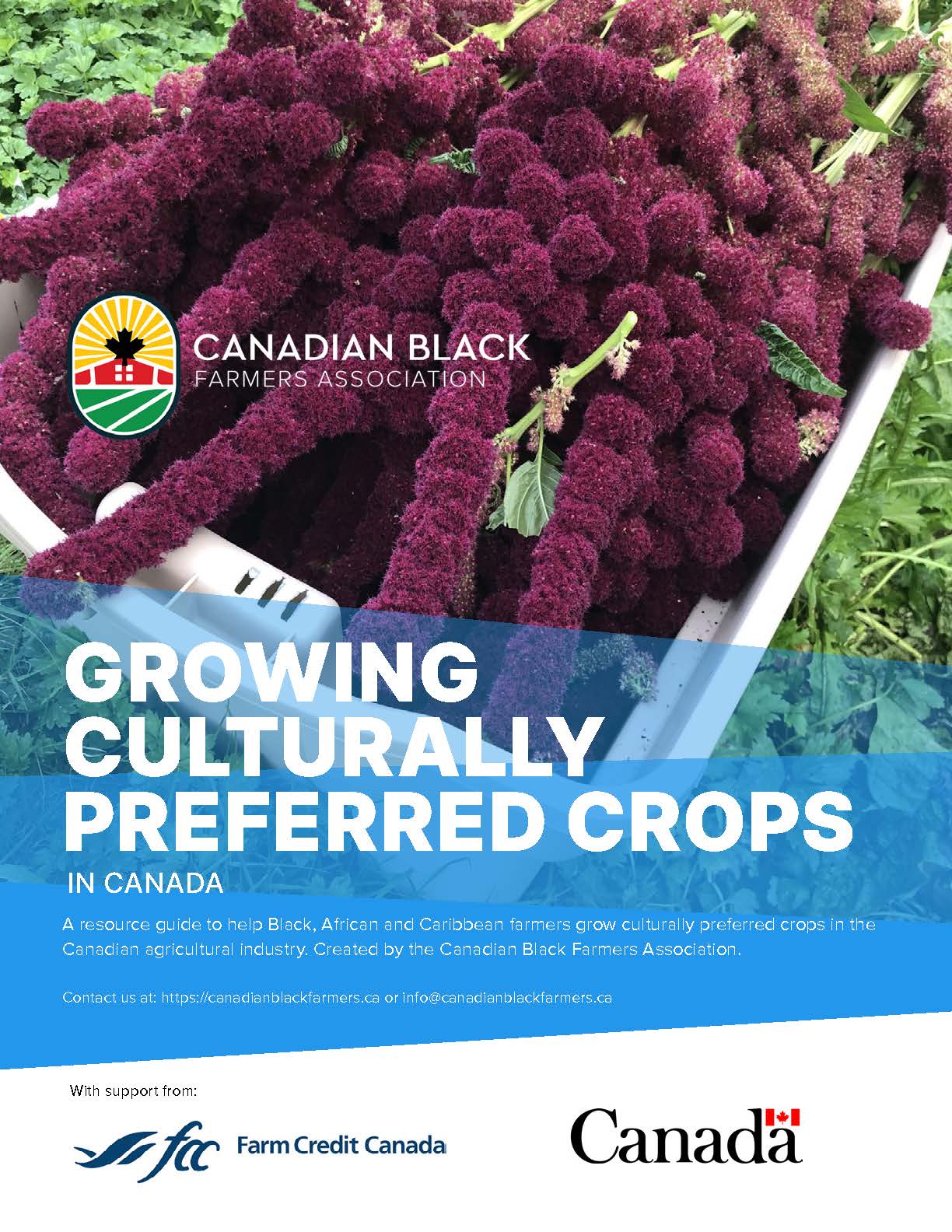
The Canadian Black Farmers Association is producing a series of resource guides to help you navigate your way through the agricultural industry here in Canada. The guide; Growing Culturally Preferred Crops is designed to help Black, African and Caribbean farmers identify and establish culturally preferred crops in Canada.
You can click to download our full PDF, or scroll down to read the guide content right online. Use the table of contents on the right to help you find your way to areas of interest.
Growing Culturally Preferred Crops
Executive Summary
The Canadian Black Farmers Association (CBFA) is leading a national effort to advance the cultivation of culturally preferred African and Caribbean crops within Canadian climates. Since 2020, CBFA has conducted applied research, on-farm trials, and community-based demonstrations to adapt tropical crops to Canada’s environmental conditions using climate-smart growing systems, improved soils, and greenhouse technologies.
This guide provides growers, community organizations, policymakers, and funders with practical, field-tested knowledge on how culturally significant crops can be grown successfully and economically in Canada. It outlines the cultural and economic importance of these crops, identifies those proven adaptable to Canadian regions, and presents best-practice guidance on soil systems, seed sourcing, greenhouse infrastructure, and sustainable heating strategies.
CBFA’s work directly supports food sovereignty, reduces reliance on imported produce, and creates pathways for small-scale and commercial farmers particularly within Black, African, and Caribbean communities to participate meaningfully in Canada’s agricultural economy. The guide also highlights regional considerations and scalable production models that align with national priorities on food security, climate resilience, and inclusive economic development.
About the Canadian Black Farmers Association (CBFA)
The Canadian Black Farmers Association (CBFA) is a national nonprofit organization dedicated to supporting Black, African, and Caribbean communities in reclaiming agricultural heritage, overcoming systemic barriers, and building long-term economic opportunities through farming.
Since 2020, CBFA has led Canada’s most ambitious tropical crop research and production initiative. Working alongside community growers and the Kara Kata Africa Village Project, CBFA has tested, refined, and scaled the cultivation of culturally preferred African and Caribbean crops within Canadian climates.
Our approach combines ancestral knowledge, hands-on experimentation, and modern growing technologies to strengthen food sovereignty, improve access to culturally meaningful foods, reduce reliance on imports, and empower a new generation of farmers.
Cultural and Economic Significance
For many Black, African, and Caribbean communities, food is inseparable from heritage, memory, and identity. Growing culturally preferred crops in Canada supports cultural continuity, intergenerational knowledge transfer, and improved access to familiar, nutritious foods.
Economically, local production reduces dependency on imports, stabilizes food costs, and creates new income opportunities for small-scale and commercial growers. These crops also expand crop diversity within Canada’s agricultural sector while strengthening community-led food systems.
Challenges of Growing Tropical Crops in Canada
Tropical African and Caribbean crops originate in warm, humid climates. Successfully growing them in Canada requires adaptation, planning, and climate management. Common challenges include:
- Temperature sensitivity and frost risk
- Short growing seasons (100–150 frost-free days)
- Heavy or cool soils in early spring
- Inconsistent humidity and moisture
- Pest and disease pressure
- Limited access to authentic seed varieties
- Structural barriers to land access and farm infrastructure
CBFA has successfully grown dozens of tropical crops at its experimental farm through greenhouse systems, soil optimization, and season-extension strategies. These innovations are now being shared with members across provinces.
Culturally Preferred Crops Proven in Canada
The following crops have been piloted or successfully grown by CBFA based on cultural relevance, resilience, and adaptability to Canadian conditions.
Table 1: Culturally Preferred Crops and Production Requirements
| Crop Category | Crop | Cultural Use | Recommended Production Method |
| Greens | Callaloo / African amaranth | Staple leafy green | Outdoor (warm season) / Unheated greenhouse |
| Greens | Bitter leaf | Traditional soups | Heated greenhouse |
| Greens | Malabar spinach | Heat-tolerant green | Unheated greenhouse / Containers |
| Vegetables | Okra | Fresh and cooked dishes | Outdoor (warm regions) / Unheated greenhouse |
| Vegetables | African eggplant | Stews and sauces | Unheated greenhouse / Containers |
| Peppers | Scotch bonnet | Culinary and cultural spice | Unheated or heated greenhouse |
| Peppers | African bird pepper | Culinary spice | Unheated or heated greenhouse |
| Roots & Tubers | Sweet potatoes | Staple carbohydrate | Heated greenhouse / Containers |
| Roots & Tubers | Yams | Ceremonial and staple food | Heated greenhouse |
| Roots & Tubers | Cassava | Flour and fufu | Heated greenhouse |
| Roots & Tubers | Taro / eddoes | Soups and stews | Heated greenhouse / Containers |
| Grains | Maize | Cultural staple | Outdoor (warm season) |
Seed Sourcing and Seed Saving
Access to authentic African and Caribbean seeds remains limited in Canada. Growers commonly source seeds through:
- African and Caribbean grocery stores
- Community seed exchanges
- Trusted online specialty suppliers
- Farmer-to-farmer sharing
CBFA is developing long-term seed-saving initiatives to preserve resilient varieties adapted to Canadian conditions. Seed saving protects cultural food traditions while strengthening community food security.
Soil, Fertility, and the CBFA Loamy Soil Mix
Healthy soil is foundational to tropical crop success. CBFA developed the CBFA Loamy Soil Mix, a proprietary blend designed for African and Caribbean crops grown in Canadian climates.
Key benefits include:
- Loose structure for tuber expansion
- Excellent drainage
- Warmth retention for root development
- High organic matter content
- Balanced pH
- Proven performance in CBFA trials
The mix can be used alone or blended with native soil to improve fertility and structure.
Growing Techniques and Climate Adaptations
1. Site Selection and Soil Preparation
- Select south-facing sites with full sun
- Use raised beds to improve drainage and soil warmth
- Blend native soil with CBFA Loamy Soil Mix
- Add compost or well-rotted manure
- Mulch with straw, composted leaves, bark, or grass clippings to retain moisture and heat
2. Seed Starting and Transplanting
- Start seeds indoors 6–10 weeks before last frost
- Use heat mats and grow lights to simulate tropical conditions
- Harden off seedlings gradually
- Transplant when night temperatures remain above 12–15°C
- Use deep containers or mounded beds for yams, taro, and eddoes
Season Extension by Crop Type
Consistent tropical crop production in Canada requires strategic season extension. CBFA recommends the following infrastructure approaches based on crop heat requirements.
Table 2: Crop Heat Requirements and Infrastructure Needs
| Infrastructure Type | Suitable Crops | Notes |
| Heated commercial greenhouse | Plantains, cassava, yams, taro, long-season peppers | Enables reliable yields and extended seasons |
| Unheated greenhouse / hoop house | Peppers, African eggplant, sweet potatoes, Malabar spinach | Requires careful timing and frost protection |
| Outdoor with protection | Callaloo, amaranth greens, okra (warm regions), eddoes | Use mulching, row covers, warm microclimates |
| Containers (greenhouse or outdoor) | Peppers, African eggplant, Malabar spinach, sweet potato slips | Ideal for small spaces and pilot production |
CBFA provides guidance on greenhouse design, irrigation systems, ventilation, and climate controls. One-to-one mentorship is available to members planning greenhouse-based production.
Sustainable Greenhouse Heating Research
CBFA is actively researching energy-efficient greenhouse heating systems to support year-round tropical crop production. Systems under evaluation include:
- Underground heating and thermal mass storage
- Shallow geothermal-inspired systems
- Compost-heated trench beds
- Solar-assisted heating and battery storage
- Thermal mass insulation using stone and water barrels
Findings are shared with members through mentorship and technical guidance.
Crop-Specific Notes (Quick Reference)
- Okra: Requires soil temperatures above 22°C; harvest pods young
- Callaloo/Amaranth: Fast-growing; prefers full sun and consistent moisture
- Yams: Long season; best in heated greenhouses
- Hot Peppers: Start early indoors; protect from cool nights
- Sweet Potatoes: Plant slips after frost; cure before storage
- Taro/Eddoes: Prefer warm, moist soil; suitable for containers
- Plantains: Require consistent heat; heated greenhouse essential
Care, Harvesting, and Storage
- Water deeply and consistently
- Maintain mulch for moisture retention
- Fertilize with compost or organic amendments
- Use natural pest management strategies
- Harvest greens young for tenderness
- Cure root crops before long-term storage
Regional Considerations Across Canada
British Columbia Mildest climate; outdoor greens possible in summer. Consistent tropical crop production requires heated greenhouses. CBFA’s experimental farm is located here.
Ontario and Quebec High demand due to large African and Caribbean populations. Heated greenhouses recommended for most crops; unheated structures support peppers and greens.
Prairies Short seasons and temperature extremes. Heated commercial greenhouses are required for reliable production.
Alberta Highly variable climate. Community gardens support learning, but commercial heated greenhouses are necessary for scale.
Step-by-Step Guide for New Growers
- Identify crops connected to your heritage
- Join CBFA for mentorship and support
- Source authentic seeds
- Prepare soil using CBFA Loamy Soil Mix
- Start seeds early indoors
- Use greenhouse or climate protection
- Harvest, store, and market produce
- Scale production with CBFA guidance
Conclusion
Growing culturally preferred African and Caribbean crops in Canada strengthens cultural identity, builds food security, and creates economic opportunity. With appropriate soil systems, greenhouse technology, and community knowledge, these crops can thrive in Canadian climates.
CBFA remains committed to mentorship, research, and practical support for growers nationwide. Together, we are cultivating knowledge, preserving heritage, and building resilient, community-driven agricultural futures.
Table of Contents